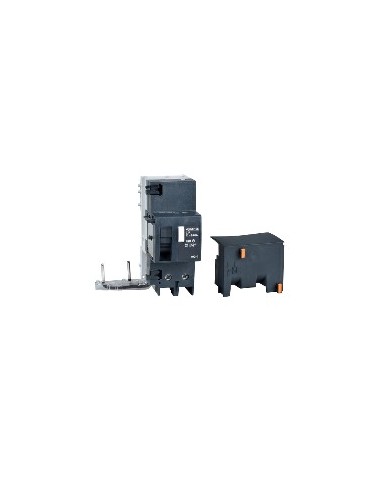
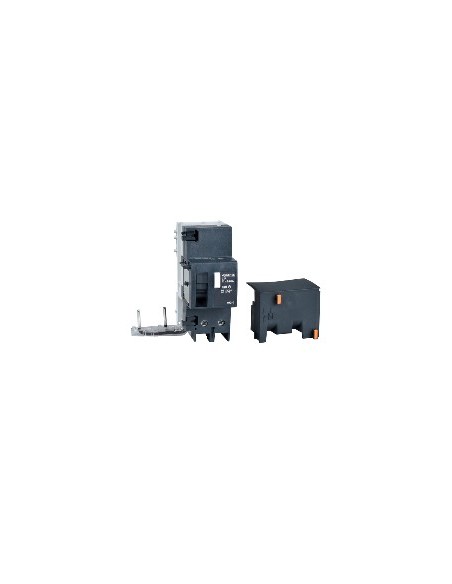
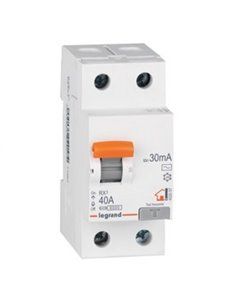
2P Vigi NG125 block with a nominal current of 63 A and earth leakage sensitivity of 300 mA, designed to protect electrical circuits in small commercial installations. Its operation is independent of voltage, ensuring reliable response on AC 50/60 Hz networks with a nominal operating voltage between 230 and 415 V. Installed at the output of the system, it provides selective protection against earth leakage.
Technical features
- Number of poles: 2P
- Nominal current [In]: 63 A
- Network type: AC
- Earth leakage sensitivity: 300 mA
- Protection delay: Selective
- System location: Output
- Network frequency: 50/60 Hz
- Nominal operating voltage [Ue]: 230...415 V AC 50/60 Hz
- Residual current tripping technology: Voltage-independent
- Nominal insulation voltage [Ui]: 690 V AC 50/60 Hz in accordance with EN> 50 A
- Surge voltage withstand [Uimp]: 8 kV in accordance with EN> 50 A
- Mounting support: Symmetrical 35 mm DIN rail
- Electrical connection to MCB: By screws
- Spacing: 9 mm, 5 steps
- Height: 118 mm
- Width: 99 mm
- Depth: 81 mm
- Product weight: 0.25 kg
- Electrical durability: 10000 cycles in accordance with EN> 50 A
- Connections - terminals: Tunnel-type terminals 1…35 mm² flexible, 1.5…50 mm² rigid
- Cable stripping length for terminal connection: 20 mm
- Torque: 3.5 N·m
- Product compatibility: Terminal
- Compatibility code: VLS
- Market segment: Small commercial
- Standards: EN> 50 A
- Protection degree IP: IP40 in accordance with EN> 50 A
- Contamination degree: 3 in accordance with EN> 50 A
- Electromagnetic compatibility: Impulse resistance 8/20 µs, 5000 A in accordance with EN> 50 A
- Tropicalization: 2 in accordance with IEC 60068-1
- Relative humidity: 95 % at 55 °C
- Maximum operating altitude: 2000 m
- Sustainable offering status: Green Premium product
- REACH Regulation: Reference does not contain SVHC
- EU RoHS Directive: Compliant
- Mercury-free: Yes
- RoHS exemption information: Yes
- China RoHS regulation: Product outside the scope of China RoHS. Substance declaration information
- WEEE: In the European Union market, the product must be disposed of according to a specific waste collection system and must never end up in a general waste bin